
Veterinary dermatology in Kyiv
This is a doctor who specializes in the diagnosis and treatment of diseases of the skin, auricles, fur, paws, claws and nose in animals.
If your pet has the following symptoms:
🐱itching – scratches itself to blood or small wounds, even if it itches rarely and you hardly notice it
🐶 intensively licks itself, especially its paws, the skin between the toes; shakes its head, rubs its muzzle, eyes with its paws, scratches its ears (ear problems are also the “territory” of the work of a dermatologist)
🐱 bald patches (alopecia) form on the skin
🐶 unpleasant odor from the skin or change in color
🐱 nodules, ulcers, thickening of the skin, etc. appear.
One of the largest segments of patients of a dermatologist is animals with a diagnosis of “allergy”. They require a special algorithm for finding out whether there is a dependence on food or environmental factors. A dermatologist deals with urgent, severe skin diseases, such as autoimmune, deep bacterial and inflammatory processes, requiring rapid intervention and accurate diagnosis. Dermatology borders and contacts many other specializations. These are endocrinology, dietetics, ophthalmology, oncology, surgery.
And this is the most important aspect of the work of a narrow-profile doctor – a dermatologist, because it is important to contact a highly qualified specialist who has extensive experience in his field. At the Veterinary Hub you can make an appointment with a dermatologist and be sure that you will be provided with full assistance in resolving the issue.
Signs of skin diseases
First of all, it draws attention to itself – itching. This is usually the leading symptom. Animals usually demonstrate it very clearly: itching, gnawing fur, rubbing their muzzle and belly on the floor, licking their paws. Skin lesions also usually do not go unnoticed – the skin turns red or darkens at the site of inflammation, thickens, swells. Scaly ridges, wounds, pustules appear.
Lesions of the skin occur more calmly and may not irritate the animal, but will be very noticeable to the owners. Baldness appears in limited areas or partial loss of wool, hair becomes dull, and tangles appear.
Most often, dermatological diseases develop slowly, gradually growing and affecting an increasingly large surface of the skin. You should not postpone a visit to a dermatologist, because over time the problem is complicated by secondary pathogens, as well as skin diseases and parasites common to humans and animals.
Signs of skin diseases
Restless behavior, the dog shakes its head cautiously, may often touch the sore area with its paws, scratches the wound, the ear is enlarged, the auricle is thickened, a sharply limited, fluctuating oblong or round swelling is visible on the inside or outside of the auricle, if an infection has occurred, a purulent process begins
Diagnosis of dermatological diseases
Science and technical progress do not stand still, so the dermatologist of the Veterinary Hub has many methods of diagnosing diseases in his arsenal – from “routine” scrapings, cytology, otoscopy to histology, skin tests for ASIT (the so-called “allergy vaccine”), as well as MRI / CT scan in case of suspected otitis media and internal otitis. All “routine” examinations are performed by the doctor at the appointment. Of course, this takes time, but the animal goes home with a preliminary diagnosis and prescribed treatment. After some time, the animals are invited for repeated examinations to monitor the treatment and correct the prescriptions.
It is necessary to find the root cause of the disease and take it under control, otherwise the disease will return. It is important for the owner to understand that sometimes the root cause is environmental factors, from which the animal cannot be freed from contact, then control must be on an ongoing basis.
In our Veterinary Hub, you and your pet will enjoy an examination and answers to your questions, you will be able to conduct the necessary diagnostics and receive treatment immediately after the examination. Our specialists use the most modern and high-quality products developed in the field of dermatology for animals. And most importantly, we have our own laboratory with a wide range of diagnostics.
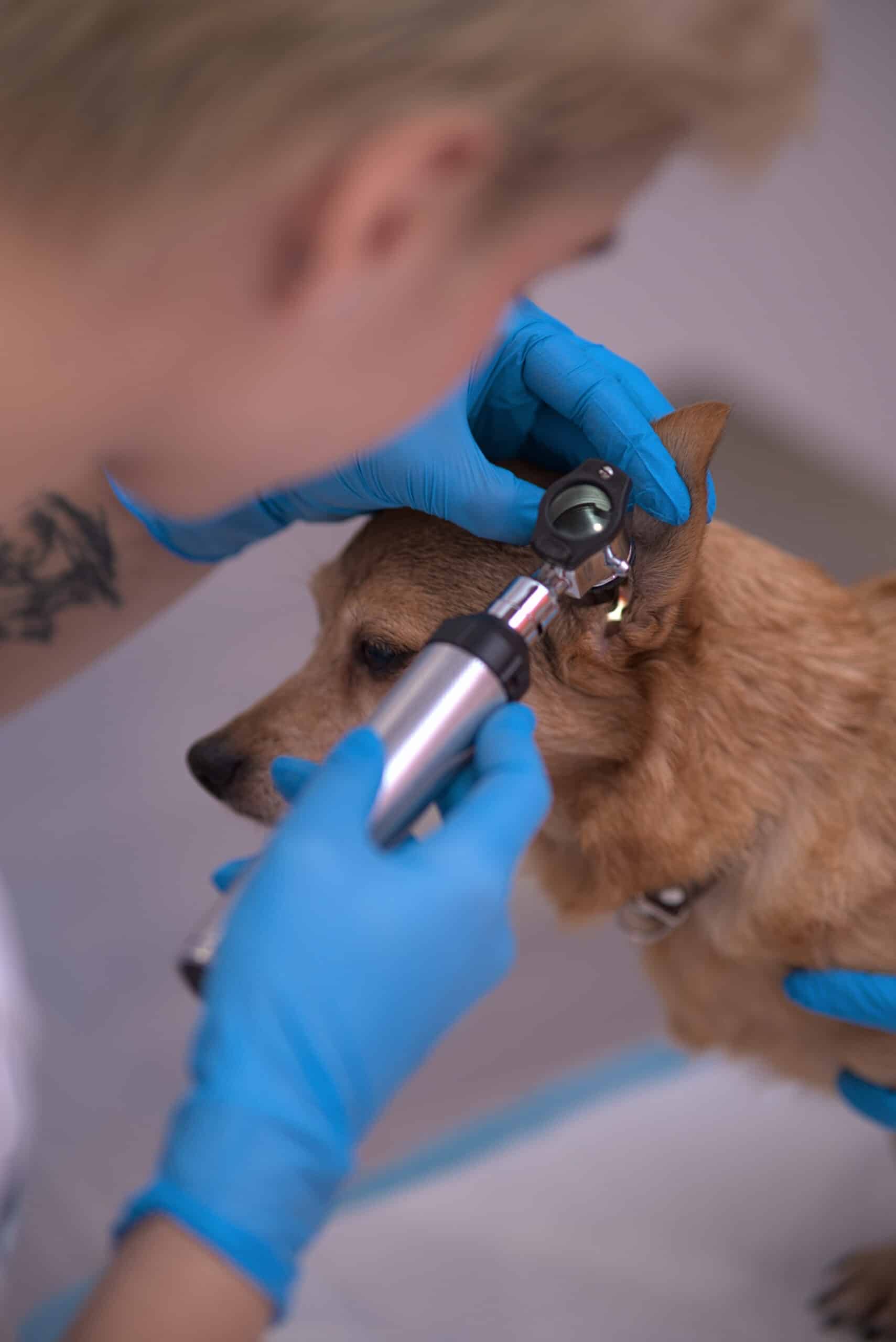
An otoscope is a device used to examine the external auditory canal, allowing you to see the real condition of the internal cavity of the organ and the eardrum. Due to its small size, the device is very mobile and convenient, and also ensures careful handling of the ears without scaring the animal.
Video otoscopy is an examination of the external auditory canal, eardrum, and some structures of the middle ear using an otoscope with a built-in video camera that transmits the image to a monitor screen.
Video otoscopy is used for:
– the best visualization of the cavity of the external auditory canal, eardrum, and middle ear;
– the highest quality sanitation of the ear canal and, as a result, a reduction in the duration of treatment for external otitis;
– the ability to penetrate the middle ear cavity to take material for bacteriological culture, as well as to wash the cavity during the treatment of otitis media (Caution! Performed under sedation);
– diagnosis and biopsy of tumors of the ear canal (Performed under sedation);
– the ability to better visualize and remove foreign bodies from the external auditory canal;
– photo and video documentation of the procedures performed.
Indications for video otoscopy are determined by a dermatologist.
Microscopy. A microscope is an optical device that magnifies the image of an object several hundred times. A microscope allows you to examine fairly large objects: hair, scales, crusts for the presence of parasites. Such objects that are not visible to the eye are cells and bacteria.
Cytology. For better visualization, smears obtained from the skin or from the ears of animals are fixed on a slide and stained. Then, under microscopy, you can see cells with different intensities of blue or red. This allows you to more clearly type bacteria and different cells. Methods for taking cytology: Skin smear. Scotch test. Fine-needle aspiration. Deep scrapings. Swab from the external auditory canal.
Skin cytology is a fast, non-invasive method that has great diagnostic value. Cytological examination of the skin or auditory canals is necessary to determine the nature of the inflammation – fungal (malassezia), bacterial (bacilli or cocci); the presence of tumor cells or cells characteristic of autoimmune skin lesions.
It is recommended not to treat the affected areas for 1-2 days before visiting a specialist.
It is worth taking your pet’s medical history with you if you have undergone diagnostic procedures and previous treatment.
The most common question is a fasting diet for taking tests for specific markers. Without a preliminary examination, it is not recommended to maintain a fasting diet. If the differential diagnosis made by a dermatologist during the examination suggests the need for tests, you will be informed of the importance of certain tests and the specificity of blood sampling for analysis.
If the problem is not only dermatological, but is complicated or secondary to endocrinology, dietetics, ophthalmology, oncology, etc., the dermatologist will refer you to a narrow-profile doctor who is needed to solve the problem and draw up a treatment protocol.
Price
-
Examination and consultation with a specialized dermatologist 850₴
-
Otoscopy 350₴
-
Scotch test (cytology) 400₴
-
Smear cytology 450₴
-
Superficial skin scraping 300₴
-
Deep skin scraping 440₴
-
Scraping from the skin and ears for the presence of ectoparasites and ringworm 400₴
-
Microscopy of biomaterial (hair, nails, skin scrapings) for pathogenic fungi (on glass) 450₴
-
Biomaterial analysis for Demodex (Demodex) (eyelashes, skin scrapings, hair, eyebrows) 500₴
Make an appointment
